How to Generate Leads for B2B Brands?
B2B lead generation is about finding businesses that could benefit from your products and services and converting them into customers. Unlike B2C, B2B buying usually involves multiple decision-makers, longer sales cycles, and a lot of research. That’s why it’s critical to develop planned strategies to generate leads for B2B brands, instead of targeting a large number of contacts. 12 Tips to Generate Leads for B2B Brands The following strategies can help generate leads for B2B brands. Let’s discuss further. Define Your Ideal Customer Profile (ICP) Your Ideal Customer Profile (ICP) is a clear description of the kind of company that gets the most value from your products or services and is most likely to become your long-term customers. You can consider the following factors when identifying your ICP. Industry Company size (employees or revenue) Annual revenue range Location Business model Common challenges they face Technologies they currently use Problems that might push them to look for a new solution Next, you need to identify individuals involved in buying decisions. Depending on what you sell, that could include CEOs, founders, marketing managers, sales directors, IT managers, procurement teams, or other department heads. A well-defined ICP helps you focus on the right prospects. Build a Conversion-Focused Website For many B2B buyers, your website is the first place they will visit to learn more about your business. Hence, along with making it visually appealing, you need to make it easy for visitors to take the next step. Create dedicated service pages to clearly explain your offerings, the problems you solve, and why someone should choose you. Further, use clear calls to action (CTAs) like “Request a Quote,” “Book a Consultation,” “Schedule a Demo,” or “Talk to an Expert.” You should keep forms short but useful. Your website should be mobile-friendly, fast, and easy to navigate. Further, the website should display trust signals, such as testimonials, case studies, certifications, client logos, and any credentials that build credibility. Use SEO to Capture High-Intent Searches SEO helps you show up when prospects are already searching for solutions like yours. Instead of interrupting people with ads, you appear right when they’re looking for help. Research keywords related to your services, industry, customer problems, and buying intent Build service pages around commercial keywords and create educational content for informational searches Focus on long-tail, problem-related searches to drive relevant prospects Optimise your site structure, content, internal links, technical SEO, and any local or industry-specific pages Structure your content for AI-powered searches. Clear explanations, helpful FAQs, original insights, and well-organised content can boost your visibility as search evolves Create Valuable B2B Content Content marketing helps prospects discover you, trust you, and engage with you. Instead of writing only to promote your services, focus on answering the questions your audience is already asking. In this regard, you can create – Blog posts Detailed guides Case studies Whitepapers Checklists Industry reports Videos Other useful resources Focus on topics related to common challenges, buying considerations, industry trends, how-to advice, and comparisons between solutions. Use LinkedIn for B2B Lead Generation LinkedIn is one of the best places to reach business owners, executives, managers, and other decision-makers. But success on LinkedIn takes more than posting promos or sending generic connection requests. Build a professional presence for both your company and key team members Share useful insights, industry observations, case studies, customer stories, educational content, and practical tips Engage with potential customers by commenting on their posts, joining industry conversations, and sharing genuinely helpful information. This builds familiarity before any sales pitch. For outbound prospecting, identify prospects based on your ICP and personalise your outreach. Mention relevant business challenges or reasons for reaching out instead of using copy-paste messages. LinkedIn marketing works best when you combine relationship-building with targeted prospecting. Develop an Effective Email Marketing Strategy Email is still one of the most effective ways to nurture B2B relationships. Since B2B buying decisions can take weeks or months, prospects often aren’t ready to buy the first time they hear from you. Build segmented email lists. Group contacts by industry, job role, interests, past interactions, or where they are in the buying journey. Personalise your messages. An email that addresses a specific business challenge will always outperform a generic sales pitch. Create nurture sequences that provide value first, then gradually introduce your products or services. For example, someone who downloads an industry guide could receive related educational content before getting an invitation for a consultation. Test different subject lines, messaging, offers, email formats, and CTAs. Track what drives engagement and conversions, then double down on what works. Invest in PPC and Paid Search Paid search (like Google Ads) helps you reach prospects who are actively looking for what you offer. Focus your budget on keywords that show commercial or buying intent. Someone searching for a specific B2B service is usually more valuable than someone doing broad research. Create dedicated landing pages that match each campaign’s message. The page should clearly explain the offer, highlight benefits, include trust signals, and make it easy to convert. Use remarketing to reconnect with visitors who viewed your site but didn’t take action. Most importantly, track actual leads, qualified opportunities, and revenue, not just clicks or impressions. That’s how you know if your ads are really paying off. Offer Lead Magnets A lead magnet is a useful resource you offer in exchange for a prospect’s contact info. It’s a low-risk way for visitors to engage with you, and for you to keep the conversation going. You can present Ebooks and detailed guides Industry reports Checklists Templates Case studies Calculators Research reports Buyer guides Audits or assessments Webinars Use Case Studies and Testimonials B2B buyers want proof that you can deliver results before they choose to buy from you. Case studies and testimonials provide that social proof and help earn B2B brand trust. Therefore, you need to create case studies that – Explain the customer’s challenge Describe the solution you provided Show how you implemented it Highlight the results achieved with numbers
From Awareness to Loyalty – The Customer Journey Everyone Ignores
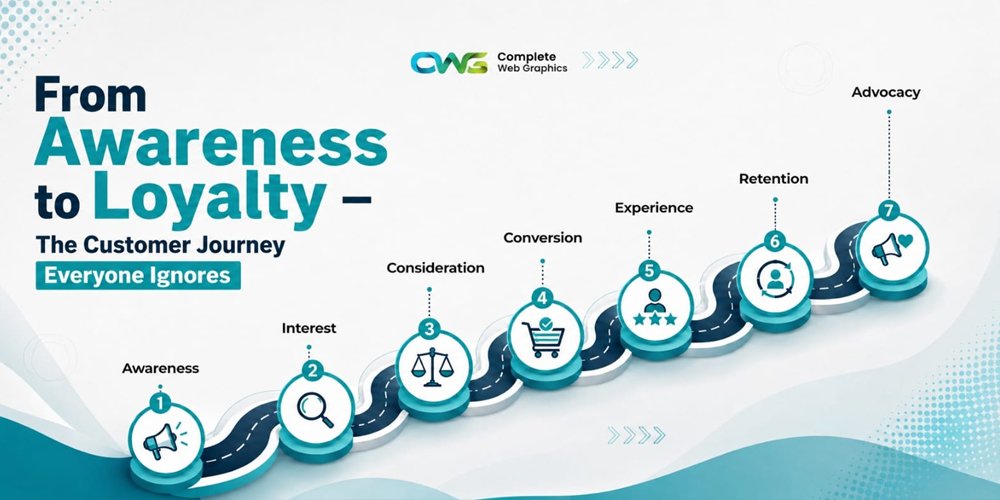
A customer journey starts with the discovery stage and culminates in repeat purchases and potential recommendations to others. It includes every interaction they have with the brand and the way it affects their perception. Understanding the different stages of the customer journey allows marketers to create personalized messages, allocate ad budget effectively, and improve conversions. Different stages of the customer journey The following are the different stages of the customer journey. Let’s discuss further. Stage 1 – Awareness In the awareness stage, a potential customer may not know your brand, understand your services, or even be actively looking to buy from you. They might have been looking for a solution to their problem and came across your brand. In this regard, they may have discovered your brand through a Google search, social media posts, paid advertisements, blog articles, referrals, online reviews, or word-of-mouth recommendations. The marketing goal at this stage is not to make an immediate sale. Instead, the focus is to improve visibility for relevant searches. Clear branding, professional design, compelling messaging, and a consistent online presence can help a business stand out from its competitors. Businesses can create blogs, videos, social posts, guides, and other resources to answer questions of their target audiences. It will help improve their search visibility for relevant queries, while also building their authority. Stage 2 – Interest While improving visibility for the right audiences is crucial, it does not guarantee a business conversion. Once a prospect becomes aware of your business, you need to encourage them to explore your solutions. It is what we call the ‘interest’ stage. In this stage, educational and engaging content plays a crucial role. A well-designed website, informative blog, helpful video, active social media profile, newsletter, or detailed service page, etc., can encourage prospects to explore your business. The marketing goal is to address customers’ needs instead of promoting the business. Stage 3 – Consideration Interest also might not lead to a guaranteed purchase. Most customers often need to consider various aspects before making a purchasing decision. In this stage, prospects actively compare your business with alternatives. They may evaluate your pricing, quality, reviews, features, etc. In this stage, the marketing goal is to build brand trust. Customers may encounter several businesses offering similar products or services. However, they are more likely to choose the one that appears credible, transparent, experienced, and capable of delivering on its promises. Social proof can significantly reduce uncertainty. Reviews, testimonials, portfolio, certifications, case studies, etc., may help earn prospects’ trust. Further, detailed service descriptions, FAQs, pricing information, product demonstrations, etc., can help customers make informed decisions. Stage 4 – Conversion In this stage, the prospect takes the desired action. While many businesses associate conversion exclusively with a purchase, it can mean different things depending on the business model. The following are different forms of conversion Making a purchase Requesting a quote Booking a consultation Scheduling a demonstration Signing up for a service Submitting a contact form Calling the sales team Registering for an account However, one of the biggest challenges businesses experience in this stage is friction. Despite customers being ready to take the desired action, they may take a step back due to a confusing website, a complicated checkout process, lengthy forms, etc. Hence, businesses need to simplify the conversion process. Strong calls to action should guide the prospects into taking the next desired action. Other elements that businesses should focus on are intuitive navigation, forms with only necessary information, a clear checkout process, convenient payment options, etc. Stage 5 – Experience The customer experience after conversion determines whether they will continue purchasing from you. In this regard, please note that a negative experience for a customer might lead to lost business opportunities. Hence, businesses need to ensure their customers have a satisfactory experience with their products and services. To achieve that, setting expectations is crucial. If your customers know what to expect, they will likely have a positive experience with your brand. Businesses should also ensure that the experience matches the promises made during marketing and sales. Otherwise, it can affect brand trust and credibility. Stage 6 – Retention Customer retention focuses on maintaining the relationship with the customers after the initial purchase. It focuses on giving customers compelling reasons to continue doing business with you. Businesses can strengthen relationships through personalized brand messages, follow-ups, loyalty programs, exclusive offers, product recommendations, educational content, and relevant re-engagement campaigns. Purchase history, browsing behaviour, service usage, previous interactions, and preferences can help businesses understand what customers may need next. Accordingly, businesses can use this insight to create more useful experiences. Besides, customer service plays a crucial role in improving customer retention. For instance, if a customer receives fast and helpful support when needed, they will likely become loyal to the brand. Stage 7 – Advocacy The final stage of the customer journey is advocacy. It occurs when satisfied customers go beyond purchasing from your business and actively recommend it to others. The following can be different forms of advocacy – Online reviews Testimonials Referrals Social media mentions User-generated content Word-of-mouth recommendations Recommendations from real customers can help build better brand credibility compared to traditional advertising. A prospective customer might trust an authentic review from an actual customer instead of a promotional claim made by the company itself. Businesses may encourage their existing customers to share reviews or user-generated content. Customers do not always move through these stages in a straight line. Every customer journey is different. However, by understanding different stages and how different touchpoints affect this journey, brands can help plan their marketing strategies accordingly. Complete Web Graphics is a trusted digital marketing agency in India. We can help plan customized digital marketing strategies to boost organic traffic and website visitors, thereby creating opportunities for generating more leads and improving conversions.
How Can Brand Consistency Help With Long-Term Success?
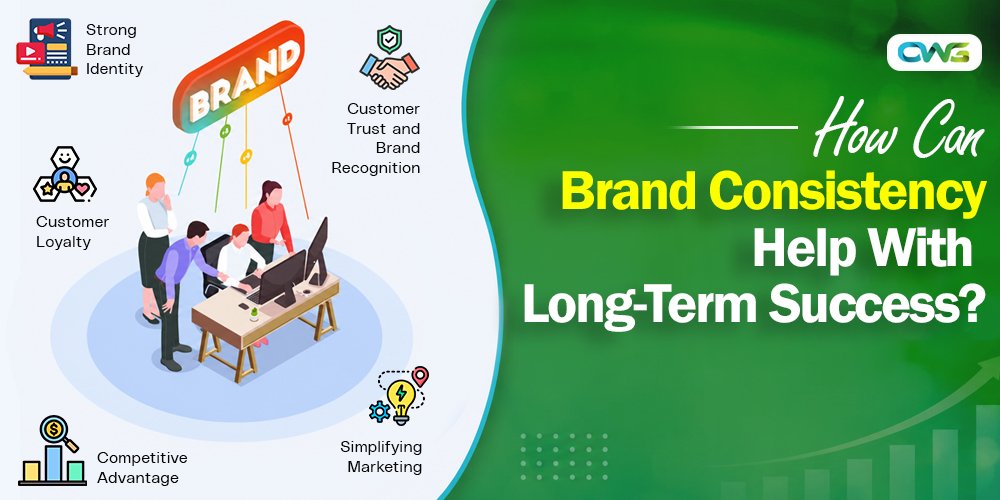
Brand consistency is presenting a consistent visual identity, messaging, and value across every customer touch point. Regardless of the platform a customer interacts with a brand, the visual elements, tone, etc., should be easily recognizable. Maintaining brand consistency is crucial for achieving long-term success of a business. Benefits of Brand Consistency for Ensuring Long-term Success Maintaining brand consistency helps businesses achieve long – term success. Let’s discuss further. Establishing a Strong Brand Identity Maintaining brand consistency across every customer touch point is crucial in building a strong brand identity. Your business logo, color palette, typography, imagery, tone of voice, and brand messaging help create a unified experience wherever customers interact with your business. Whether they visit your website, social media profiles, receive an email, or purchase your products, every interaction should reinforce the same identity and values. Consistent branding helps customers recognize your business instantly. It also helps create a memorable and professional image. A cohesive visual identity, combined with clear and consistent brand messaging, helps your audience better understand your business. Maintaining brand consistency across all marketing channels helps create a seamless customer experience. It further improves brand recognition, credibility, and builds lasting relationships. Eventually, it supports customer acquisition, retention, and long-term business growth. Building Customer Trust and Brand Recognition Consistent branding also helps build customer trust. Consumers are more likely to buy from a brand they trust. When customers repeatedly encounter the same brand identity, visual elements, and messaging, they develop familiarity and confidence in your business. Usually, consumers need multiple interactions with a brand before making a purchasing decision. Every consistent experience, whether through social media, search results, email marketing, or your website, can help reinforce your brand messaging. It further helps improve brand recognition. With increased familiarity and trust, customers will likely choose you over your competitors. Enhancing Customer Loyalty Through Consistent Branding Brand consistency helps build long-term customer loyalty. Customers prefer businesses that deliver reliable experiences, clear communication, and consistent quality. When every interaction aligns with your brand identity, customers are likely to feel more confident returning to your business. A consistent customer experience includes customer service, product quality, website usability, social media engagement, and post-purchase support. Every positive interaction strengthens emotional connections with your audience. Retaining existing customers is more cost-effective than acquiring new ones. By investing in consistent branding, businesses can improve customer satisfaction. It further helps encourage repeat purchases, increase referrals, and maximize customer lifetime value. Loyal customers also become brand advocates who help expand your reach through positive reviews and word-of-mouth recommendations. Brand Consistency Creates Competitive Advantage In today’s crowded marketplace, businesses need more than quality products or competitive pricing to stand out. A consistent brand identity helps your business stand out from competitors. It helps make your brand easier to remember. When customers repeatedly experience the same visual identity, messaging, and brand values, they develop stronger brand recall. As a result, your business will likely be the first one they remember of f when they need a product or service within your industry. Consistent branding also creates emotional connections. Customers who trust your brand are less likely to switch based solely on price or promotions. The reason is that they will likely value the familiarity, reliability, and brand experience. As a result, brand consistency is crucial to support long-term market growth. Simplifying Marketing with Brand Consistency Brand identity is crucial for improving marketing efficiency. When your marketing team follows established brand guidelines, they can maintain consistency across all marketing materials and every communication channel. Whether developing website content, social media campaigns, blog articles, email newsletters, digital advertisements, or printed materials, every asset reinforces the same brand messaging and visual identity. Comprehensive brand guidelines include logo usage, approved color palettes, typography, imagery, writing style, messaging frameworks, and content standards. These guidelines ensure that employees, agencies, and external partners consistently represent the brand, regardless of who creates the content. A centralized asset library helps marketing teams access the latest approved files, reduces design inconsistencies, improves collaboration, and ensures brand consistency across every campaign. By combining detailed brand guidelines with centralized brand assets, businesses can streamline their marketing processes. It further helps improve campaign performance, strengthen brand recognition, and deliver a consistent customer experience to support business growth. Therefore, maintaining brand consistency is crucial for businesses to support their long-term growth. Complete Web Graphics offers customized branding and design services to support your business growth. Get in touch with our expert, and we can help you develop brand guidelines to maintain consistency across all marketing channels.
Brand Awareness Mistakes Businesses Should Avoid
Customers usually prefer buying from brands they are familiar with. Hence, building brand awareness is crucial for customers to know your brand, what you offer, trust you, and eventually buy from you. However, businesses often make a few mistakes in terms of brand awareness campaigns. As a result, these efforts do not generate any meaningful results. These include targeting the wrong audience, inconsistent messaging, not measuring campaign performance, etc. Avoiding these mistakes and focusing on campaigns that produce measurable results will help improve brand awareness. Common Brand Awareness Mistakes to Avoid The following are a few common brand awareness mistakes that businesses should avoid. Let’s discuss further. Targeting a broader audience One of the common brand awareness mistakes that brands often commit is that they target a broader audience. While this might seem like higher brand exposure, it may lead to lower campaign efficiency. Broad audience targeting often increases advertising costs and may not produce enough engagement. In such conditions, it is critical to identify your target audience. Creating detailed buyer personas can help businesses understand who their ideal customers are. Additionally, audience segmentation allows you to group customers according to demographics, interests, behaviours, geographic location, or purchase intent. Accordingly, brands can target their audiences effectively. Inconsistent brand messaging across channels In the present day, audiences interact with brands across multiple platforms, such as websites and social media. Therefore, brands must maintain consistent messaging across all platforms. Inconsistent branding, such as variations in logo usage, colour schemes, typography, imagery, and overall visual identity, is one of the common brand awareness mistakes that can affect overall brand recognition. If customers cannot easily identify your brand across different touchpoints, it can be challenging to build familiarity and trust. A strong brand identity involves clear brand guidelines that define your brand voice, messaging style, visual elements, etc. Brands need to maintain consistency across all customer interactions, including advertising campaigns, blog posts, customer support responses, and email newsletters. It helps strengthen recognition and builds credibility. Ignoring marketing analytics and performance data Analytics is crucial for identifying which campaigns generate awareness, which audiences respond best, or which creative assets perform most effectively. It will further help you focus on campaigns that are providing better business results and remove ineffective strategies. Therefore, ignoring analytics can become one of the most costly brand awareness mistakes. In this regard, brands need to measure metrics that actually matter. Some of the key brand awareness metrics are branded search volume, direct traffic, referral traffic, brand mentions, and social media engagement. Not focusing on campaign optimisation Brand awareness campaigns require continued optimisation to achieve better business results. Hence, it is crucial to A/B test different headlines, images, videos, and calls-to-action to identify which creative elements resonate most with your audience. Further, marketers should refine audience segments based on campaign performance. It will allow them to allocate larger budgets to high-performing audiences while reducing spend on underperforming ones. Continuous campaign monitoring and optimisation can help maximise the return on investment. Prioritising short-term sales over long-term brand building Many marketers often expect immediate results from their brand awareness campaigns. It is one of the most common brand awareness mistakes that businesses tend to commit. Unlike direct-response campaigns, brand awareness campaigns focus on introducing your brand in the market, building familiarity, and establishing trust. Customers typically move through several stages of the sales funnel before making a purchase. Brand awareness creates initial recognition, consideration encourages prospects to assess your offerings, and conversion occurs when they are ready to buy. Skipping the awareness stage can make it challenging to drive qualified customers later in the buying journey. Producing generic content In this digital landscape, customers are exposed to thousands of marketing messages every day. Therefore, if your content uses the same generic phrases, stock images, and predictable messaging as your competitors, your audience may not remember your brand. Therefore, you need to communicate how your products or services are different. A unique value proposition is crucial to encourage your customers to choose your brand over others in the market. In this regard, you need to share content that helps you connect with your audience emotionally. Sharing your company’s mission, values, customer success stories, and industry expertise helps create meaningful relationships. You can publish educational blogs, videos, webinars, case studies, and helpful resources to position your business as a trusted authority. Choosing the wrong marketing channels Brands need to understand that not every marketing platform is suitable for every business. You should refrain from maintaining a presence on every available social media platform. Such brand awareness mistakes can result in wasting resources. In this regard, identify the platforms your target audience is mostly active on. Accordingly, keep your campaign limited to those platforms. Inconsistent campaign frequency Running brand awareness campaigns occasionally or stopping marketing efforts after a short period can prevent customers from developing familiarity with your brand. Hence, it is crucial to maintain a regular publishing and advertising schedule. It will help keep your business visible throughout the customer journey. As a result, it will help your business remain top of mind with your audience when they make purchasing decisions. Neglecting mobile user experience As users spend a significant portion of their day on mobile phones, you cannot ignore the mobile user experience. Slow-loading websites, difficult navigation, and poorly optimised landing pages often cause visitors to leave before engaging with your content. Businesses should ensure their websites are mobile-responsive, load quickly, and provide seamless user experiences across all devices. Optimising landing pages for mobile users improves engagement, reduces bounce rates, and creates a positive brand impression. Ignoring customer feedback and social engagement Customers often interact with businesses through comments, reviews, social media messages, and online discussions. Ignoring these interactions can damage brand perception and reduce customer trust. Hence, businesses should promptly respond to customer feedback to show that they value the opinions of their audiences. It will help create a positive brand image. Therefore, by avoiding these brand awareness mistakes, businesses can use their
How to Identify Your Target Audience in 2026?
Today, the digital landscape is highly competitive. As a result, consumers are constantly exposed to personalized content, targeted advertisements, and tailored experiences across multiple channels. As a result, businesses must understand who their target audiences are. Identifying your target audience allows you to create relevant messaging, allocate marketing resources more effectively, and build stronger relationships with potential customers. Types of Target Audiences Understanding the different types of target audiences helps businesses create more personalized marketing campaigns and deliver the right message to the right people. The following are the different types of target audiences- Demographic Audience – This type of audience is defined by measurable characteristics such as age, gender, income, education level, occupation, marital status, etc. Geographic Audience – This type of audience is segmented based on geographic location, including country, state or region, city, etc. Psychographic Audience – This type of audience is grouped according to values and beliefs, lifestyle choices, interests and hobbies, personality traits, etc. Behavioral Audience – This type of audience is based on how people interact with products, services, or brands. It includes purchasing behavior, brand loyalty, product usage frequency, online activity, buying stage, etc. B2B (Business-to-Business) Audience – Companies that sell products or services to other businesses often segment audiences by industry, company size, revenue, job title, decision-making authority, etc. Interest-Based Audience – This type of audience is categorized by specific interests such as technology, travel, sports, fashion, etc. Intent-Based Audience–These audiences are targeted based on their intent behind their searches. These include informational, navigational, commercial, and transactional. Customer Lifecycle Audience – These audiences are categorized based on their position in the customer journey. It includes prospects, leads, first-time customers, repeat customers, loyal advocates, etc. Importance of Identifying Your Target Audience Identifying your target audience is essential for creating marketing campaigns that resonate with the right people. It allows you to tailor your communications, offers, and content to their specific needs and interests. It leads to more effective marketing, higher engagement, and better ROI. More Personalized Customer Experiences Understanding your audience’s needs, preferences, and pain points allows you to create personalized content that is relevant and valuable. Personalized interactions help improve customer satisfaction and strengthen relationships throughout the buyer journey. Stronger Brand Voice and Messaging Knowing your audience makes it easier to develop a brand voice that connects with your audience. You can frame your messaging to match the expectations and interests of different customer groups. It helps make your brand more relatable and memorable. Increased Brand Loyalty and Advocacy Customers who feel understood are more likely to trust your brand and remain loyal. Satisfied customers often become brand advocates, recommending your products or services to others. It helps broaden your audience reach through positive word-of-mouth. Improved Customer Retention Retaining existing customers is often more cost-effective than acquiring new ones. By understanding your audience and consistently delivering relevant experiences, you can build long-term customer relationships. Further, it helps improve audience retention and maximize customer lifetime value. Better Products and Services Your target audience can provide valuable insights into what works, what doesn’t, and what improvements they would like to see. Feedback from customers helps businesses refine existing products, identify new opportunities, and develop solutions to meet market needs. More Effective Marketing Campaigns Defining target audiences allows businesses to focus their marketing efforts on the channels, content, and strategies most likely to drive results. It helps improve campaign performance, reduce wasted advertising spend, and increase conversion rates. Steps to Identify Your Target Audience Defining your target audience is a crucial step in creating effective marketing strategies. By understanding who is most likely to benefit from your products or services, you can tailor your marketing efforts accordingly to drive conversion. The following steps can help identify and refine your target audience. Step 1: Evaluate Your Products or Services Analyze your brand offerings and determine who would likely benefit from them. You can identify the problem that your product or service can help solve. Consider the challenges, needs, or pain points that your solution addresses and how it can help your customers. Furthermore, identify the characteristics of people who would benefit most from your solution. Consider factors such as their lifestyle, profession, interests, or business needs. Finally, define your unique selling proposition (USP) that sets your offering apart from competitors. Understanding your USP will help you identify the audience most likely to respond to your brand. Step 2: Conduct Market and Competitor Research Once you have a basic understanding of your ideal customers, broaden your research by examining the market and your competitors. Analyze businesses that offer similar products or services and the audiences they target. Review competitor websites, social media channels, customer reviews, and marketing campaigns to gain valuable insights. You can also use analytics and SEO tools to understand market trends and discover audience interests that align with your offerings. Step 3: Develop Detailed Buyer Personas A buyer persona is a semi-fictional representation of your ideal customer based on research and data. Creating buyer personas helps you better understand your audience’s preferences and challenges. Your buyer persona should include information such as: Age and gender Occupation and industry Education level Income range Geographic location Goals and aspirations Pain points and challenges Interests and hobbies Preferred communication channels Buying behaviors and decision-making factors You can gather this information through customer surveys, interviews, website analytics, and sales data. Creating multiple personas may be necessary if your business serves different customer segments. Step 4: Identify the Right Marketing Channels Analyze your buyer personas to determine the platforms, websites, and channels they use most frequently. For example, younger audiences may be more active on social media platforms, while professionals may prefer industry publications, email newsletters, or professional networking platforms. Identifying the right channels ensures your marketing efforts reach the right people and deliver the greatest impact. Additionally, consider the type of content and messaging that resonates with each audience segment. Different groups may respond better to videos, blogs, webinars, social media posts, or email campaigns. Step 5:
Brand Awareness Metrics Every Business Should Track
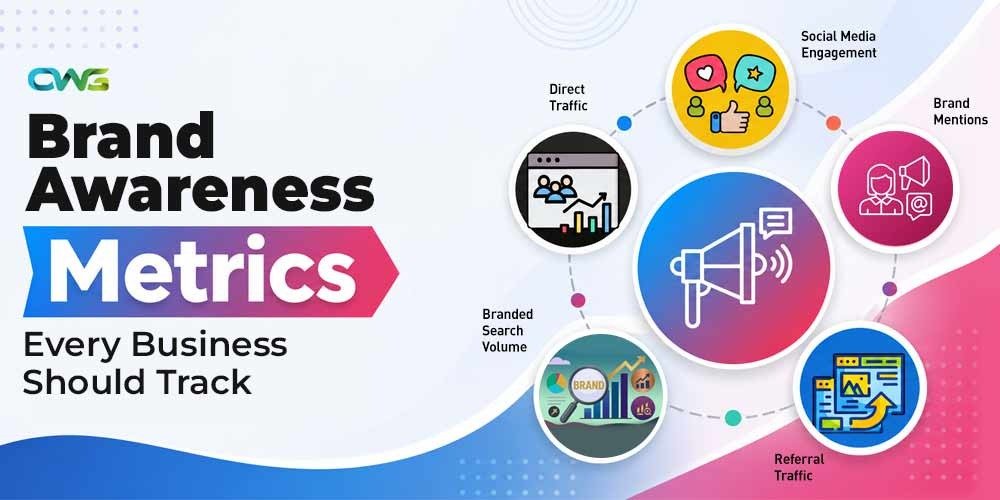
Brand awareness plays a major role in influencing customer trust, engagement, and purchasing decisions. However, simply running marketing campaigns is not enough. To understand whether your efforts are truly making an impact, you need to track the right brand awareness metrics. It will further allow you to modify your marketing strategies for better brand awareness. Critical aspects of Brand Awareness The following are the crucial aspects of brand awareness. Let’s discuss further. Brand Recognition – It is a key aspect of brand awareness. It indicates the ability of a consumer to recognize you brand by your logo, slogan, packaging, etc. Brand Recall – It measures the ability of a consumer to remember your brand name when they have a specific need. It implies that your brand is on top of their mind when they are looking for a specific product or services similar to yours. Brand Perception–Positive experiences, good customer service, and a strong reputation all contribute to how consumers perceive a business. A positive brand image helps build stronger awareness over time. Customer Trust – Trust plays a major role in brand awareness. People are more likely to choose brands they trust. Businesses that regularly deliver quality products or services tend to earn higher trust from customers. Competitive Advantage – A well-known brand often has an advantage over competitors. When consumers are already familiar with a business, they are generally more comfortable choosing it instead of a lesser-known option. Customer Loyalty – Strong brand awareness can lead to long-term customer loyalty. When customers have positive experiences with a brand, they are more likely to return for future purchases and recommend the business to others. Easier Market Entry – For new businesses or products, building brand awareness is crucial. It helps introduce the brand to potential customers and creates a foundation for future growth and recognition. Measuring Marketing Success – Businesses also use brand awareness metrics to evaluate their marketing efforts. Tracking changes in visibility, engagement, and audience reach can help determine how effective advertising campaigns, social media activities, and other strategies are. Brand Equity – Brand awareness is a key part of brand equity, which refers to the overall value and strength of a brand. The more familiar and trusted a brand becomes, the stronger its overall market value can grow. 5 Brand Awareness Metrics That Businesses Should Track The following are crucial brand awareness metrics that businesses should track. Branded Search Volume It refers to the number of times people search for your business name, product name, or services on search engines. These searches show that people already know about your brand and are actively looking for it online. A high branded search volume is often a strong sign that your marketing efforts are working. When more people search for your brand directly, it usually means your business is becoming more recognizable and memorable. This metric also helps improve your online visibility. Search engines tend to view frequently searched brands as more trustworthy and relevant. As a result, your website may appear higher in search results, not only for your brand name but also for related industry keywords. Increased branded searches can also improve your chances of appearing in suggested searches and related search results, helping more people discover your business. Tips to Improve It The following tips can help improve branded search volume. Create helpful and informative content to answer your audience’s questions to showcase your expertise Maintain active social media profiles Publish blogs regularly Optimize your website content for relevant keywords Strengthen internal linking structure Over time, consistent branding and valuable content can encourage more people to search for your business directly. Direct Traffic It refers to visitors who land on your website by typing your URL directly into their browser or accessing it through saved bookmarks. It can also include users who already know your brand and visit your website without coming from a search engine or external website. Direct traffic is a strong indicator of brand familiarity and customer interest. When people visit your website directly, it usually means they already recognize your business and intentionally want to learn more about your products or services. A steady increase in direct traffic often suggests growing brand awareness and customer trust. It also signals to search engines that your website is valuable and relevant, which can positively impact your search rankings and online visibility. Tips to Increase It The following tips can help increase your direct traffic. Make your website easy to remember, user-friendly, and mobile-responsive Create content that matches the needs and interests of your audience Create content based on your audience intent Create content for different stages of the customer journey to encourage repeat visits and improve overall engagement with your brand Referral Traffic It refers to the visitors who come to your website through links on other websites rather than through search engines. This can include traffic from blogs, online directories, social media platforms, review sites, news articles, and other external sources. Referral traffic helps expose your business to new audiences. When people discover your website through trusted external sources, it can improve your credibility and increase awareness of your brand. Strong referral traffic often means your content is being shared, recommended, or discussed online. It can also lead to more leads, customer inquiries, and conversions because visitors arriving from trusted sources are often already interested in your industry or services. Tips to Increase It The following tips can help increase referral traffic Create valuable content that others want to share or reference Guest blogging Publish informative articles Join industry discussions Collaborate with other businesses Engage with communities online Write thoughtful comments on relevant blogs, discussions, etc Share useful insights on social media Focus on providing value instead of only promotional messages. Brand Mentions It refers to the time someone mentions your brand online or offline. They can appear in social media posts, blog articles, online reviews, videos, forums, comments, or news stories. Sometimes your brand may be tagged directly, while other
Local SEO Strategies to Appear in Google AI Overviews
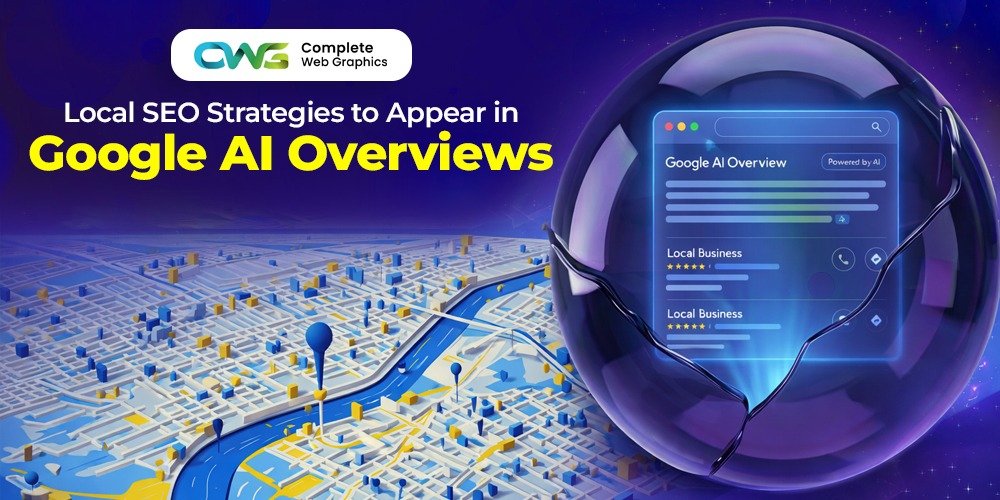
AI Overviews are AI-generated results that appear at the top of Google SERP. Google’s large language models (LLMs) analyse information from various relevant sources to present answers on the SERP. It also includes the list of resources for generating answers. Users can further check these resources by clicking on the links. Generative search results and Google AI Overviews play a critical role in how users are discovering local businesses. Hence, it has become critical for local businesses to optimize their website and content to improve visibility in Google AI Overviews for related searches. 8 tips to improve visibility of local businesses in Google AI Overviews The following tips can help improve the visibility of local businesses in Google AI Overviews. Let’s discuss further. Maintain NAP Consistency Across Directories NAP implies Name, Address, and Phone Number. AI models cross-reference your business details across the web. Hence, maintaining consistent business information is crucial across all directories. It helps build brand credibility. In addition to Google Business Profile, identify top directory listings in your industry. Ensure that your business name, address, and phone number are consistent across all these directories. If any changes to your business information occur, remember to update them across all directories. Optimize your Google Business Profile AI Overviews pulls information from your Google Business Profile (GBP) for local searches. Therefore, you must optimize and maintain your GBP to allow AI to display updated news for your brand. In this regard, if you haven’t yet claimed and verified your profile, do so now. Next, select the right business categories. Additionally, upload real photos of your business, team, etc. It will allow AI models to consider your brand credible. Besides, you should post updates consistently. Further, you should add accurate and updated information related to business hours, website URL, phone number, and service area on your profile. Develop a review generation strategy Customer reviews on Google, Yelp, and other industry-specific directories are indexed and public. AI models actively pull these reviews when generating local search results. In this regard, you can ask every satisfied customer for a review within 24-24 hours. You can make it frictionless by sending a direct link to your Google review page in a follow-up email or text. As the experience is still fresh, chances are higher that customers will provide a detailed review. Visibility of such detailed reviews in local searches can boost brand impression. Besides, you should respond to every client review. AI models also index your responses. Hence, your regular response to customer reviews will indicate you have an active business. Create an FAQ page and sections AI models often pull out answers from well-structured pieces of content. Hence, creating FAQ content will allow you to present answers to AI in their preferred format. As a result, it will help create better opportunities to improve your visibility in AI Overviews. You can create a dedicated FAQ page or FAQ sections in all web pages (home, about us, service, etc.). In this regard, identify the questions your target audience will likely type in Google searches. You can also consider the questions you get from customers over email, on calls, in person, etc. Accordingly, include them in your FAQ sections in each service page along with plain and direct answers. It will allow AI to associate each question and answer with a specific service. Add Schema Markup across Your Website Schema Markup is a piece of structured code that you add to your website to help search engines and AI understand the context of your content. You can use various schema generator tools available for free online. Next, you can add the code to the <head> section of your HTML. Further, validate your schema. The following are the Schema types you should prioritize – FAQ Schema for dedicated FAQ page and FAQ sections on service pages Local Business Schema is critical for local search visibility Article Schema for blog posts and news content Person Schema for team members Earn quality third-party guest posts and media mentions More than quantity, you should focus on earning quality backlinks from credible sources. The reason is that AI models trust sources that other trusted sources refer to. For instance, a guest post on a business journal, a brand mention in a reputed local publication, etc., will add more value to your brand. In this regard, identify credible publications in your industry that accept guest contributions. Next, pitch a genuine answer to a question that your audience will likely have. It is better to build a relationship with reputed publications and engage with them genuinely before making a pitch. Add Author Bios Search engines and AI models assess Experience, Expertise, Authoritativeness, and Trustworthiness (E.E.A.T) for displaying any answer on search results. Therefore, adding author bios to your blog pages can signal search engines about your credibility. In this regard, add a bio block, including the author’s name, job title, and full headshot photo to every blog post. Additionally, add 2-3 sentences describing the author’s relevant expertise. Further, link the author’s name to their dedicated page that displays all their posts and additional details on their background. Share content across other platforms Distributing content across community-driven platforms or social media channels helps create more indexed touchpoints, which can improve the brand’s presence and establish topical authority. In this regard, you can share all your blogs on your active social media channels. Further, repurpose your FAQ content into social media posts. It is also better to track engagement to identify the type of posts that resonate most with your audience. Accordingly, create a blog and FAQ content on those topics. AI Overviews is a critical aspect of Google searches. By improving your visibility in this section, you can improve your brand’s presence, while indirectly driving audience to your website. The strategies we discussed in this blog will help you optimize your content to improve the visibility of your local business in Google AI Overviews. Complete Web Graphics is a trusted SEO agency
How Magento More than a E-Commerce Platform ?

Recently every E-Commerce Platform has been targeting Majento development. But do you think Magento is more than a E-Commerce Platform ? The potential of the e-commerce industry is only proliferating with each passing day. With more awareness among customers, they are not staying away from the concept of online shopping. They are flashing their plastic money to pick up items and goodies at throwaway prices. The convenience of buying from home is another major draw for these customers. While it makes a lot of business sense to have a website and e-commerce division for your brand, it is equally important to have a competent site for the job. Your website will not make healthy sales if it looks or acts shabby. You have to compete with the look and feel of bigger brand names in the e-commerce sector like Amazon or e-Bay. Customers will not find any credibility in your website if the platform and interface do not match up to their standards, especially for those who are regularly shopping on those bigger e-commerce platforms. Magento is one platform for your e-commerce business that can really put your brand into the big league. It is a stable, dependable platform. We have written about the benefits of Magento website development in an earlier blog post. Today we will discuss why this platform is more than what meets the eye. There are some add-ons that help your brand further in developing that perfect e-commerce venture. uDropship is an integral add-on on Magento. With this, you can expand your potential for drop shopping, a supply management system by which you need not store or ship products to customers. Instead, you can pass on the shipping details to the manufacturer directly for shipping. It saves costs at your end and helps you offer more products because you don’t have the headache to store or ship them. uDropshop allows you to handle this whole operation smoothly. Magento Debug is the next big add-on. As the name gives away, it takes care of all the niggles that may crop up during the daily operations of Magento. Despite being a stable platform, you can never say when something crops up. The debug program lets you focus on other things by resolving issues as and when they come up. Finally, the Sweet Tooth extension of Magento is a loyalty program for those who are frequently buying from your online store. With this add-on, you can offer them rewards and bonus points by keeping track of their purchases easily. Your sales will get a shot in the arm with this add-on because customers love it when they are rewarded for something!
Brand Awareness – Reaching the Right Audience to Ensure Long-Term Success
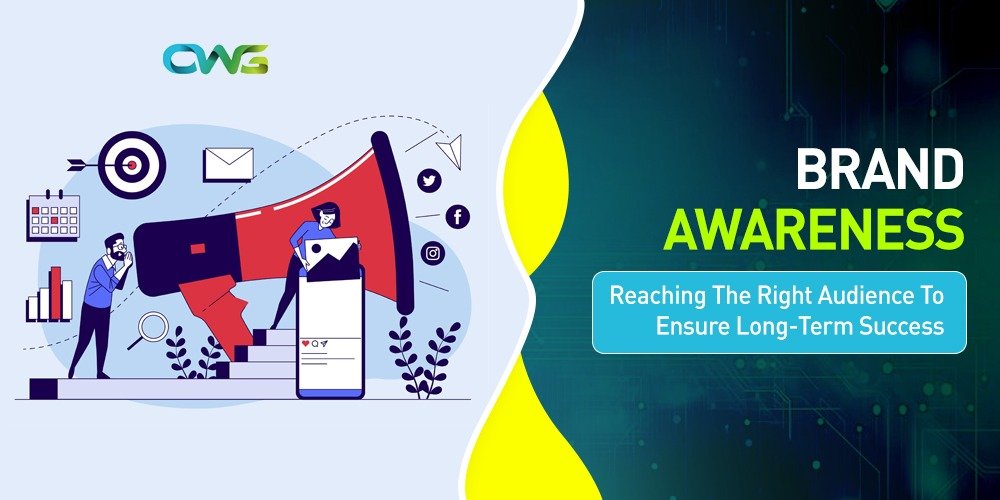
Brand awareness measures how familiar audiences are with your business. A higher level of brand awareness implies that more prospects are familiar with your brand, logo, and your offerings. Further, brand awareness is much more than promoting the specific offerings of a business to the prospects. It is crucial to stand out from competitors, build trust, earn customer loyalty, and retain customers. Different Levels of Brand Awareness The following are the different levels of brand awareness. Brand recognition – It refers to the audience’s ability to identify a brand based on various visual elements, such as logo, tagline, colour scheme, etc. At this stage, they might not be aware of the brand offerings; however, they recognize the brand if they come across it. Brand recall – It implies that the audience can think of a brand spontaneously if they are prompted by a product category or industry. Top-of-mind awareness – It is the highest level of brand awareness. It implies that your brand is the first name that comes to your audience’s mind whenever they link about the product and service category you offer. Put simply, if your target customers have a need and your brand is the first name they can think of, you have achieved the top-of-mind brand awareness status. 3 Benefits of Brand Awareness Brand awareness involves reaching the relevant audiences, making them aware of your brand and its offerings, earning their trust, and eventually building a long-term relationship with your customers. Hence, it is essential for your business’s success. The following are some of the benefits of brand awareness. Building trust and credibility Brand awareness is crucial for building trust and credibility. The more familiar users are with a brand, the more likely they are to consider it reliable. Further, audiences tend to buy from a brand they trust. Hence, brand awareness is crucial for building trust and eventually converting them into paying customers. Customer loyalty and retention Brand awareness plays a crucial role in earning customer loyalty and retaining them. Customer retention implies that repeat customers can contribute to a significant portion of sales and profit. Brand awareness can help nurture long-term relationships with customers, which can guarantee repeat purchases. Further, customer loyalty goes beyond repeat purchase. It can help create brand advocates, who are likely to refer their preferred brand to their acquaintances and purchase whenever there are new offerings. Competitive advantage When brands achieve brand recall or top-of-mind awareness status, they gain a competitive advantage. The reason is that they become a preferred go-to option for their target audiences. As a result, regardless of how competitive their industry gets, their loyal customers and brand advocates will continue purchasing from them and promoting them to their acquaintances. All these can contribute to their success and growth despite competition. Tips to Boost Brand Awareness for Long-Term Success The following tips can help boost your brand awareness, reach the right audiences, earn their trust, convert them into loyal customers, and ensure long-term business growth. Content Content plays a crucial role in delivering your brand message, supporting your branding efforts, informing and educating your audiences about your offerings, etc. Therefore, when planning strategies to boost brand awareness, you cannot ignore the role of content. In this regard, you can include the following types of content in your strategies. Freemium – It involves offering new customers a free version of a product or service to get them acquainted with the offerings. If the experience is a positive one, this effort will likely bring more regular customers. Examples include offering free samples of any product online, access to a product or service for a limited time, or a free trial period for a service, which customers can later pay to get a premium version, etc. Blogs – It is an effective way to build a brand. Brands can publish informative blogs on their website to show their expertise in a specific industry and build their authority. Besides, by optimizing blogs with relevant keywords, they can help boost your organic search ranking. As a result, it helps create opportunities to boost visibility among relevant audiences. Infographics – They are pretty effective in boosting audience engagement. Besides, they allow you to present complex information in an easy-to-understand way. Additionally, they are a great way to share content on social media and rank for visual searches. Both these aspects can lead to increased online visibility and thereby help with spreading brand awareness. Videos – Videos are a great way to introduce your brand offerings. Besides, these formats are easy to share, allowing more opportunities to reach a broader audience. Guest content – Publishing guest content helps you earn links from other authority sites. It helps create a positive brand impression. Besides, it signals search engines that your website is credible, which further helps boost your online presence. Leveraging social media Another effective way to build your brand awareness is to promote your offering on relevant social media channels. For instance, identify who your target audiences are and their preferred platforms. Accordingly, develop effective social media marketing strategies to promote your brand on specific platforms to reach the right audiences. Creating valuable content that resonates with your audience can help boost your brand awareness. Further, you can collaborate with micro-influencers in your industry for effective brand promotion. Thus, by leveraging the power of social media, you can effectively boost your brand awareness. Invest in advertising While we are at it, we suggest investing in advertising. In this regard, running ad campaigns on both search engines and social media can help boost your brand visibility, easy recall, and even help you reach the top-of-mind awareness stage. Monitoring online reputation Brands should regularly check online reviews and social media channels for customer feedback. Addressing negative feedback and even taking steps to solve it can contribute to a positive brand reputation. By monitoring online reputation, brands can measure their perception among target audiences and take steps to improve it. Therefore, by following all these steps,
Web Development – Secret Tips To Build Better Websites
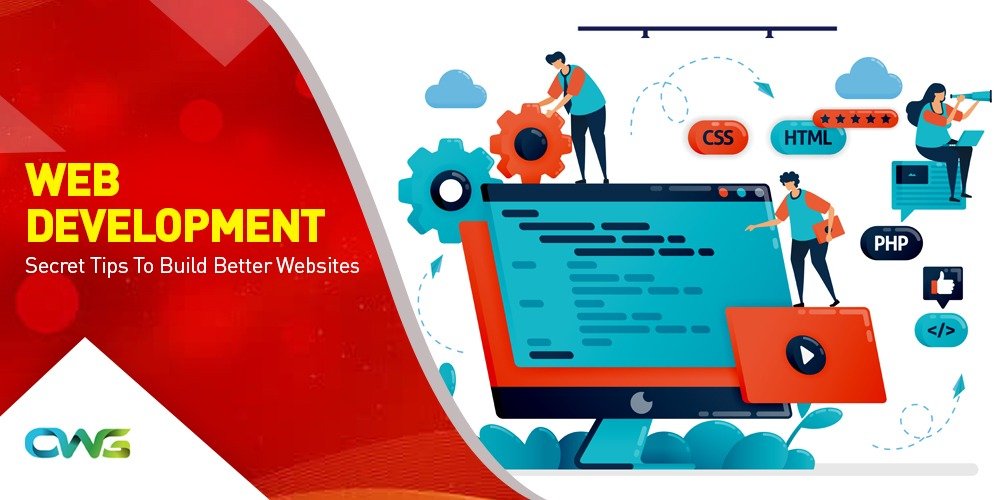
Your website is an online identity that lets your users know more about your brand and its offerings. A well-structured, user-friendly, fast-loading, mobile-responsive, and easy-to-navigate website can help build trust. Besides, when used effectively, a well-built website can help meet your business goals. This blog will share some of the secret web development tips for better websites. User experience If your users are not satisfied with their experience on your website, they are likely not to spend more time exploring it. As a result, it can prevent you from utilizing your website effectively to achieve your business goals. Therefore, when designing and developing your website, focus on the following aspects to improve user experience. Fast loading speed Intuitive navigation Visual consistency Easy-to-read layouts Accessibility A seamless user experience can encourage visitors to explore your website. It can further help create opportunities for lead generation and business conversion. Strong and secure back-end system While the appearance of a website helps drive the audience’s attention, its functionality is what makes users stay. Hence, along with front-end development, you need to give equal emphasis to back-end development. It helps your website function properly and protect sensitive data. An effective back-end includes selecting the right server setup, implementing security protocols, using efficient databases, ensuring regular backups, and monitoring performance and uptime. Further, the right back-end system ensures your website can handle traffic spikes without compromising on speed and performance. Mobile-responsive layout A significant number of website traffic comes from mobile devices. Hence, you need to build mobile-responsive websites to ensure your users can access your website across all devices. Responsive website design implies your website can adjust to different device sizes without compromising on its performance. Enhance visual and functional appeal The visual design of a website plays a crucial role in building a strong first impression. Ensure your website is visually-pleasing and easy-to-use. Factors such as clear call-to-action buttons, logical layout, easy navigation, etc., can help improve user experience. Besides, a professional-looking website helps build trust, which is crucial for conversion. Optimize performance and speed As users have low attention spans, even a delay of a second can cause users to leave a website even before properly landing on it. Hence, you need to optimize your website for performance and speed. Using reliable hosting, cleaning up code, reducing unnecessary plugins, compressing images, etc., can help speed up your website. Further, ensure adding caching systems and content delivery networks (CDNs) to help your website load faster. Ensure content freshness Content plays a crucial role in improving your website’s performance. Maintaining content freshness and relevance can help you build trust and credibility. It will further encourage your users to keep coming back to your website for more updates. Further, it will signal search engines that your website is reliable and updated, which can further help boost your organic ranking. Consistent publishing of blogs, product updates, helpful guides, how-to videos, industry insights, customer success stories, etc., can help maintain content freshness. It can help boost engagement and earn trust. Add relevant call-to-actions When your web visitors take the desired action on your website, it indicates that your website is successful. In this regard, placing relevant call-to-actions on strategic position on your website is crucial. It will guide your visitors to take the next action. It can include filling out a form, seeing a video, clicking on a link to another page on your website, downloading a sample, etc. Therefore, by focusing on all these aspects, you can help build an effective website. Complete Web Graphics is a web development agency. Regardless of the type of website your business needs, our web developers can help build customized solutions accordingly. You can get in touch with our web development team for further assistance.