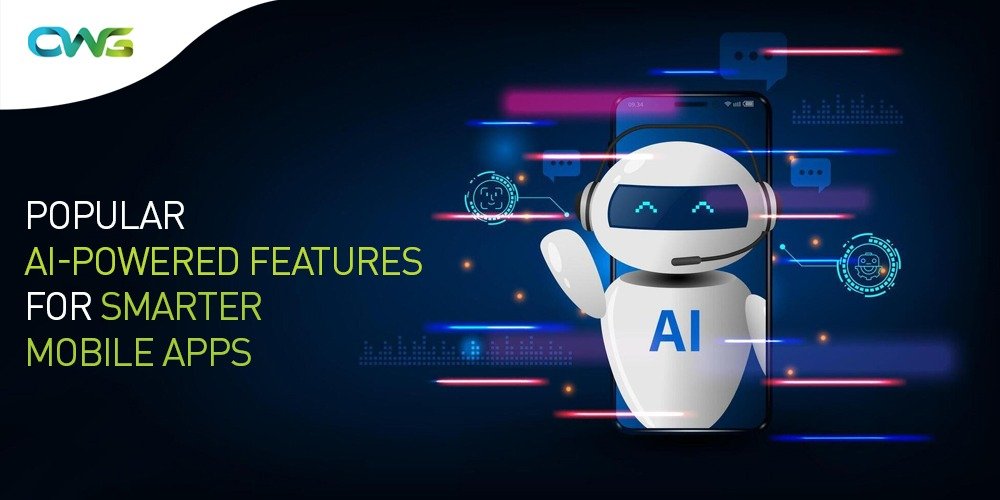
Artificial Intelligence (AI) is making mobile applications faster, more innovative, and more intuitive. AI-powered features are changing the way users interact with mobile apps. From voice assistants to predictive recommendations are more, these AI-powered features are changing the mobile app experience for users.
Benefits of AI-powered features in mobile apps
AI-powered features in mobile apps offer a highly personalised user experience. Let’s discuss the other benefits of these features.
- Personalisation – AI analyses user behaviour and presents customised content, product recommendations, etc.
- Enhanced user experience – AI-powered features, such as smart search, voice recognition, etc., help make the mobile apps more intuitive.
- Improved security – AI helps identify potential threats, thereby enhancing app security and protecting user data.
- Automation and support – AI-powered chatbots offer 24/7 efficient customer support.
- Improved accessibility – Advanced AI-powered features, such as image recognition, improve accessibility by making apps inclusive for all users.
Popular AI-powered features in mobile apps
The following are some of the common AI-powered features in mobile apps. Let’s discuss further.
AI-powered chatbots
These features help deliver real-time support and assistance to users. Many mobile apps use Natural Language Processing (NLP) and sentiment analysis to generate human-like conversations. These apps offer personalised interactions. Businesses often use such chatbots to improve their customer service, which further helps with their retention.
Voice assistants
Voice assistants, such as Siri, Google Assistant, etc., use machine learning (ML) and advanced speech recognition algorithms to answer questions, perform various tasks, etc. AI-powered voice assistants continue to improve their contextual understanding through user interactions. It further allows them to perform diverse tasks, such as making calls, setting reminders, managing smart devices, etc. These features improve accessibility, efficiency, and streamline everyday tasks.
Personalised recommendation
Many platforms, such as Spotify, Netflix, etc., analyse user behaviour and preferences to recommend personalised content to users. These platforms use ML models to process large datasets and accordingly recommend customised playlists, watchlists, etc. It further enhances user satisfaction and retains them.
Image and facial recognition
AI-based image and facial recognition apps use deep learning models to detect, analyse, and classify images and objects. Besides, such features also power authentication features in smartphones to allow secure access.
Predictive text and autocorrect
You can find these features in mobile apps, such as Grammarly. They leverage NLP and contextual learning to predict user input. Accordingly, they help improve writing accuracy. Based on their capability to adapt to individual writers’ writing style, they are widely used for fixing grammatical errors, suggesting words and phrases, etc. As a result, they help improve typing efficiency and communication.
Smart cameras and filters
These features available in apps such as Google Lens use computer vision (CV) and deep learning to identify objects, apply augmented reality (AR) effects, enhance images, etc. For instance, Google Lens uses this feature to allow users to interpret objects, texts, etc., through their cameras.
Real-time language translation
AI translators help in instant cross-language experience, such as live captions, voice interpretation, etc. Therefore, they help remove language barriers for global users.
As you can see, AI-powered features are helping enhance the mobile app experience for the users. Complete Web Graphics is a mobile app development agency. Regardless of the type of mobile app you want to develop for your business, get in touch with our team for the required assistance.