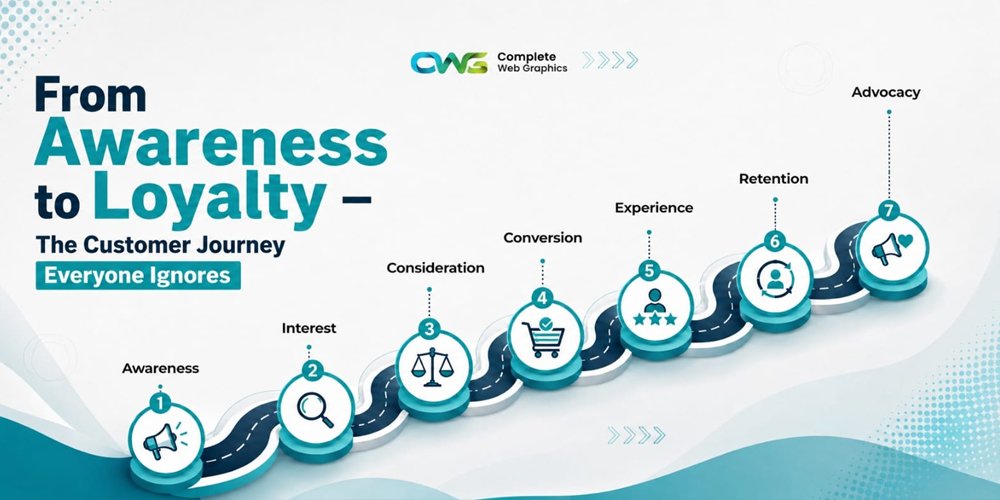
A customer journey starts with the discovery stage and culminates in repeat purchases and potential recommendations to others. It includes every interaction they have with the brand and the way it affects their perception. Understanding the different stages of the customer journey allows marketers to create personalized messages, allocate ad budget effectively, and improve conversions.
Different stages of the customer journey
The following are the different stages of the customer journey. Let’s discuss further.
Stage 1 – Awareness
In the awareness stage, a potential customer may not know your brand, understand your services, or even be actively looking to buy from you. They might have been looking for a solution to their problem and came across your brand. In this regard, they may have discovered your brand through a Google search, social media posts, paid advertisements, blog articles, referrals, online reviews, or word-of-mouth recommendations.
The marketing goal at this stage is not to make an immediate sale. Instead, the focus is to improve visibility for relevant searches. Clear branding, professional design, compelling messaging, and a consistent online presence can help a business stand out from its competitors. Businesses can create blogs, videos, social posts, guides, and other resources to answer questions of their target audiences. It will help improve their search visibility for relevant queries, while also building their authority.
Stage 2 – Interest
While improving visibility for the right audiences is crucial, it does not guarantee a business conversion. Once a prospect becomes aware of your business, you need to encourage them to explore your solutions. It is what we call the ‘interest’ stage. In this stage, educational and engaging content plays a crucial role. A well-designed website, informative blog, helpful video, active social media profile, newsletter, or detailed service page, etc., can encourage prospects to explore your business. The marketing goal is to address customers’ needs instead of promoting the business.
Stage 3 – Consideration
Interest also might not lead to a guaranteed purchase. Most customers often need to consider various aspects before making a purchasing decision. In this stage, prospects actively compare your business with alternatives. They may evaluate your pricing, quality, reviews, features, etc. In this stage, the marketing goal is to build brand trust. Customers may encounter several businesses offering similar products or services. However, they are more likely to choose the one that appears credible, transparent, experienced, and capable of delivering on its promises.
Social proof can significantly reduce uncertainty. Reviews, testimonials, portfolio, certifications, case studies, etc., may help earn prospects’ trust. Further, detailed service descriptions, FAQs, pricing information, product demonstrations, etc., can help customers make informed decisions.
Stage 4 – Conversion
In this stage, the prospect takes the desired action. While many businesses associate conversion exclusively with a purchase, it can mean different things depending on the business model. The following are different forms of conversion
- Making a purchase
- Requesting a quote
- Booking a consultation
- Scheduling a demonstration
- Signing up for a service
- Submitting a contact form
- Calling the sales team
- Registering for an account
However, one of the biggest challenges businesses experience in this stage is friction. Despite customers being ready to take the desired action, they may take a step back due to a confusing website, a complicated checkout process, lengthy forms, etc. Hence, businesses need to simplify the conversion process. Strong calls to action should guide the prospects into taking the next desired action. Other elements that businesses should focus on are intuitive navigation, forms with only necessary information, a clear checkout process, convenient payment options, etc.
Stage 5 – Experience
The customer experience after conversion determines whether they will continue purchasing from you. In this regard, please note that a negative experience for a customer might lead to lost business opportunities. Hence, businesses need to ensure their customers have a satisfactory experience with their products and services. To achieve that, setting expectations is crucial. If your customers know what to expect, they will likely have a positive experience with your brand. Businesses should also ensure that the experience matches the promises made during marketing and sales. Otherwise, it can affect brand trust and credibility.
Stage 6 – Retention
Customer retention focuses on maintaining the relationship with the customers after the initial purchase. It focuses on giving customers compelling reasons to continue doing business with you. Businesses can strengthen relationships through personalized brand messages, follow-ups, loyalty programs, exclusive offers, product recommendations, educational content, and relevant re-engagement campaigns.
Purchase history, browsing behaviour, service usage, previous interactions, and preferences can help businesses understand what customers may need next. Accordingly, businesses can use this insight to create more useful experiences. Besides, customer service plays a crucial role in improving customer retention. For instance, if a customer receives fast and helpful support when needed, they will likely become loyal to the brand.
Stage 7 – Advocacy
The final stage of the customer journey is advocacy. It occurs when satisfied customers go beyond purchasing from your business and actively recommend it to others. The following can be different forms of advocacy –
- Online reviews
- Testimonials
- Referrals
- Social media mentions
- User-generated content
- Word-of-mouth recommendations
Recommendations from real customers can help build better brand credibility compared to traditional advertising. A prospective customer might trust an authentic review from an actual customer instead of a promotional claim made by the company itself. Businesses may encourage their existing customers to share reviews or user-generated content.
Customers do not always move through these stages in a straight line. Every customer journey is different. However, by understanding different stages and how different touchpoints affect this journey, brands can help plan their marketing strategies accordingly. Complete Web Graphics is a trusted digital marketing agency in India. We can help plan customized digital marketing strategies to boost organic traffic and website visitors, thereby creating opportunities for generating more leads and improving conversions.